
Warning: Illegal string offset 'ts_pf_list_data' in /home2/bespokes/public_html/drneetusharma/wp-content/themes/optico/includes/core.php on line 1471
Warning: count(): Parameter must be an array or an object that implements Countable in /home2/bespokes/public_html/drneetusharma/wp-content/themes/optico/includes/core.php on line 1472
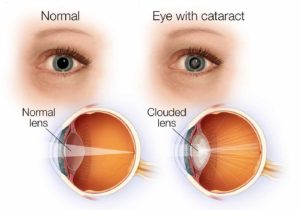
What Is a Cataract?
A cataract is a clouding of the normally clear lens of your eye. For people who have cataracts, seeing through cloudy lenses is a bit like looking through a frosty or fogged-up window. Clouded vision caused by cataracts can make it more difficult to read, drive a car (especially at night) or see the expression on a friend’s face.
Most cataracts develop slowly and don’t disturb your eyesight early on. But with time, cataracts will eventually interfere with your vision.
A cataract begins when proteins in the eye form clumps that prevent the lens from sending clear images to the retina. The retina works by converting the light that comes through the lens into signals. It sends the signals to the optic nerve, which carries them to the brain. It develops slowly and eventually interferes with your vision.
Symptoms of Cataracts
Common symptoms of cataracts include:
- Blurry vision
- Trouble seeing at night
- Seeing colors as faded
- Increased sensitivity to glare
- Halos surrounding lights
- Double vision in the affected eye
- A need for frequent changes in prescription glasses
Types of Cataracts
- There are different types of cataracts. They’re classified based on where and how they develop in your eye.
- Nuclear cataracts form in the middle of the lens and cause the nucleus, or the center, to become yellow or brown.
- Cortical cataracts are wedge-shaped and form around the edges of the nucleus.
- Posterior capsular cataracts form faster than the other two types and affect the back of the lens.
- Congenital cataracts, which are present at birth or form during a baby’s first year, are less common than age-related cataracts.
- Secondary cataracts are caused by disease or medications. Diseases that are linked with the development of cataracts include glaucoma and diabetes. The use of the steroid prednisone and other medications can sometimes lead to cataracts.
- Traumatic cataracts develop after an injury to the eye, but it can take several years for this to happen.
- Radiation cataracts can form after a person undergoes radiation treatment for cancer.
Prevention of Cataracts
To reduce your risk of developing cataracts:
- Protect your eyes from UVB rays by wearing sunglasses outside
- Have regular eye exams
- Stop smoking
- Eat fruits and vegetables that contain antioxidants
- Maintain a healthy weight
- Keep diabetes and other medical conditions in check
Treatment of Cataracts
Surgery is recommended when cataracts prevent you from going about your daily activities, such as reading or driving. It’s also performed when cataracts interfere with the treatment of other eye problems. The surgical removal of cataracts is a very common procedure and is highly effective
How To Prepare For Cataract Surgery
- Before undergoing cataract surgery, you will need to undergo fitness assessment by a physician to ensure that your body functions and common parameters like BP, Blood Sugar, ECG etc are well controlled.
- You may be advised not to eat or drink for a few hours prior to your surgery.
- In order to lower the infection risks, antibiotic eye drops may be prescribed one day prior to your scheduled surgery day.
- Ensure your companion stays with you at the hospital on the day of the cataract surgery. This can be mental support for you, they can assist in you some paperwork and consent process and will ensure that you are able to go back home without any difficulty or logistics issue.
During the Cataract Surgery
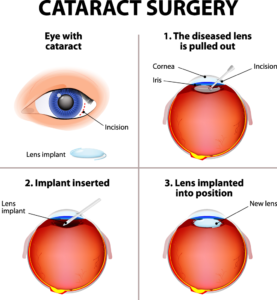
Cataract surgery is a quick (out-patient) procedure, which means that you can go home the same day. The entire procedure from in to out of the hospital usually takes a few hours only. Your eyes will be numbed using local anesthetic drops. This makes your eyes numb so that you don’t feel the pain during the procedure. In this surgery, the cloudy lens is removed and is replaced with a new intraocular lens (IOLs) in the same capsule of the lens.
Phacoemulsification :
A very tiny incision is made on the edge of the cornea and a thin probe is inserted inside the eye. Ultrasound waves are passed through this probe. These waves break up your cataract. The fragments are then suctioned out. Capsule of your lens is left behind to make a provision for the artificial lens placement.
Extra-Capsular Cataract Extraction (Manual Small Incision Cataract Surgery):
In this procedure, a slightly larger cut is made. Surgical tools are inserted through the cut to remove the nucleus of your lens and then remaining cortical matter of the lens is then aspirated. Capsule of the lens is left behind for the artificial lens to fit. This technique may need stitches.
After the cataract has been removed, an artificial lens called IOL or intraocular lens is implanted. This lens may be made of silicone, plastic or acrylic. Some IOLs are able to block out UV light and there are others that provide both near and distant vision correction called as Multifocal or Trifocal lens.
Laser Cataract Surgery :
There is a femtosecond laser technology available to assist in cataract surgery. With the help of the laser tiny cut is made and the front capsule of the lens is removed. However, with femto laser technology, we still cannot perform the full cataract surgery. It can only help in some initial parts of the surgery and after that we need to use the phacoemulsification machine to remove the actual cloudy lens.
Eye Care After Cataract Surgery :
- Avoid touching hands to your eyes.
- Take bath below the neck every day and shave after 10 days.
- Place cotton in boiling water for ten minutes. After it cools down, squeeze the cotton and clean the eyelids and the corners of the operated eye with clean hands.
- Avoid dusty public places for at least 8 days after discharge.
- Protect your eyes with sunglasses for 2 weeks.
- Be careful when you are around children as they may get close to your eye.
- Do not lift heavy objects and do not strain to pass the motion. If constipated, consult the doctor.
- Refrain from reading or watching television for 1-2 days.
- Avoid sleeping on one side of your bed, especially on the operated eye for 2-3 days