
LASIK (laser-assisted in situ keratomileusis) is the most commonly performed laser eye surgery to treat myopia (near sightedness), hyperopia (far sightedness) and astigmatism. Like other types of laser refractive surgery, the LASIK procedure reshapes the front surface (cornea) of the eye to enable light entering the eye to focus on the retina without glasses or contact lenses. LASIK typically is pain-free and requires only about 15 minutes to treat both eyes. Vision improvement is immediate and often stabilizes in as little as 24 hours.
The most common vision problem an individual faces is near-sightedness or myopia. This condition gives blurry vision for far away objects, while near vision is normal. This error in vision can be detected by routine eye check-ups at any stage when one faces difficulty in seeing distance objects clearly.
As we grow older, our eyes too show signs of ageing. Presbyopia is an age-related eye condition wherein the lens in the eye loses its ability to focus sharply leading to poor functioning of accommodation. In this condition, one can see far away objects clearly but for near objects, they require spectacles for better vision quality.
Further, Astigmatism is another eye condition wherein your cornea or lens is curved more steeply in one direction than the other is. Hence, images that you see will be blurred both for far and near. It is often present at birth and may be seen in combination with myopia and hyperopia.
The LASIK procedure
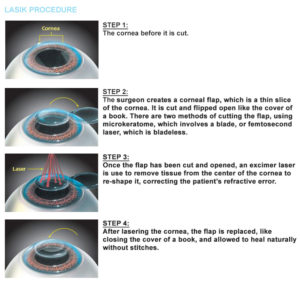
There are three essential steps to a LASIK procedure:
- A mechanical surgical tool called a microkeratome or a femtosecond laser is used to create a thin, circular flap in the cornea. The surgeon then folds back this hinged flap to access the underlying cornea (called the stroma
- An excimer laser is used to reshape the corneal stroma. This highly specialized laser uses a cool ultraviolet light beam to remove (“ablate”) microscopic amounts of tissue from the cornea to reshape it so it more accurately focuses light on the retina for improved vision.
- The corneal flap is laid back in place, where it adheres to the corneal stroma without stitches.
What to expect
Before LASIK, the Eye doctor will perform a thorough eye examination to determine if you are a good candidate for LASIK vision correction. During this exam, the surface of your eye will be examined to make sure you have no unusual risk of dry eyes after LASIK. An automated instrument called a corneal topographer will be used to create a detailed, point-by-point map of the shape of your cornea. An additional measurement called a wavefront analysis of your cornea also may be performed to help you achieve the best LASIK outcome possible.
You should stop wearing contact lenses for a period of time advised by your doctor (typically at least two weeks prior to LASIK). This is important because contact lens wear can alter the natural shape of your cornea and could affect the outcome of your procedure.
During LASIK. Immediately before your LASIK surgery, numbing eye drops are applied to your eye to prevent any discomfort during the procedure. Your doctor may also give you some medication to help you relax. Your eye will be positioned under the laser, and an instrument called a lid speculum is used to keep your eyelids open.A suction ring is applied to the front of your eye to prevent eye movements or loss of contact that could affect the quality of the corneal flap.
After the corneal flap is created, the surgeon then uses a computer to adjust the excimer laser for your particular prescription. You will be asked to look at a target light for a short time while he or she watches your eye through a microscope as the laser sends pulses of light to your cornea. The laser light pulses painlessly reshape the cornea, but you may feel some pressure on your eye. You’ll also hear a steady clicking sound while the laser is operating. The laser treatment itself takes only about a minute.
ReLEx SMILE lasik is the most advanced option. It is also called bladeless flapless Lasik. In this procedure with the help of an advanced platform called Visumax laser is focused in the internal layers of the cornea and a small lenticule is created which is removed through a tiny little laser induced cut on the side of the cornea. SMILE Lasik is not just an advanced procedure but also the safest.
Immediately after LASIK you will be asked to rest for a bit. You may feel a temporary burning or itching sensation immediately following the procedure. After a brief post-operative exam, someone can drive you home. You should expect some blurry vision and haziness immediately after surgery; however, for most people, vision improves immediately and stabilizes within a few days. You may be able to go to work the next day, it is advised a couple of days of rest instead. Avoid rubbing your eyes, as there’s a small chance this could dislodge the flap until it heals and adheres more securely to the underlying cornea.
Long-term. Laser eye surgery offers numerous benefits and can dramatically improve your quality of life. Most people achieve 20/20 vision or better after the surgery, but outcomes vary from person to person. You may still need to wear glasses or contact lenses following laser vision correction, though your prescription level typically will be much lower than before.